Someone Is Selling Your Brand Right Now. It Isn't You.

Jesse Xu
CTO
Guides
Someone Is Selling Your Brand Right Now. It Isn't You.
Reclaiming revenue costs less than creating it.
Think about how much brands spend competing for market share. Pouring millions into marketing just to claw back single-digit gains from each other. But there’s an easier win sitting right in front of them.
Studies show that acquiring a new customer costs 5 to 25 times more than retaining an existing one. Counterfeiters exploit this same dynamic: the customers they intercept were already yours. That's not a competitor stealing customers through better products or smarter ads. That's revenue walking out the door to someone selling fakes under your name. Stop the bleed, and you get the same 1-3% boost a massive marketing campaign might deliver, for a fraction of the cost, while also protecting your brand's reputation.
The Problem
Industry reports state that businesses lose 5-10% of revenue to counterfeits, with higher rates in luxury goods, electronics, and pharmaceuticals.
At 5%, a $20M brand is losing $1M annually. At 10%, $2M. And unlike customer acquisition, this is revenue that already exists. The demand is there. Someone else is just capturing it.
The ROI Math
ROI becomes measurable. Industry case studies have shown companies able to recover 40-50% in legitimate revenue from enforcing against counterfeit goods. A Forrester study found organizations achieving 323% ROI on brand protection over three years. When you know the baseline, you can track the impact.
Here's a comparison that puts it in perspective:
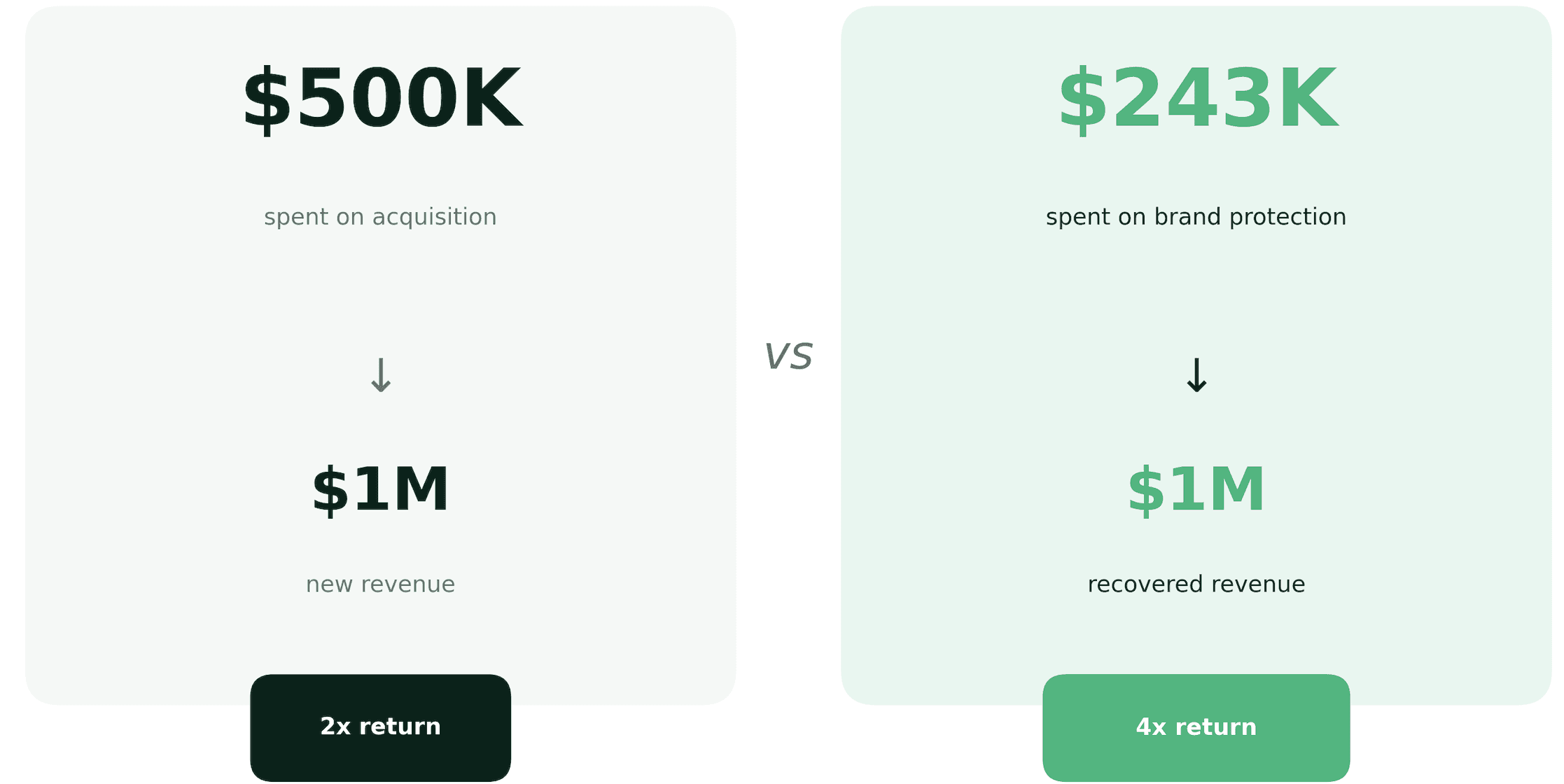
Customer acquisition cost (CAC) for a typical D2C brand runs at $30-150 per customer depending on the vertical. To generate $1M in new revenue at a $100 average order value with a $50 CAC, you'd spend $500K on acquisition.
Brand protection? Following Forrester’s ROI guidelines, reclaiming $1M would cost ~$243K – less than half of the acquisition cost.
The ROI math is different because you're not creating demand. You're reclaiming it.
What Drives Counterfeit Exposure
A few factors determine how much you're losing:
Platform coverage. Counterfeits aren't just on Amazon and eBay. TikTok Shop, print-on-demand sites like Redbubble and Printerval, and regional marketplaces in Asia and Europe all host fakes. The more platforms you're not watching, the more you're missing.
Listing volume and velocity. How many counterfeit listings exist right now? How fast are new ones appearing? A snapshot doesn't tell you much if fakes respawn faster than you take them down.
Repeat infringers. A single seller operating across 10 platforms is a bigger threat than 10 one-off listings. Research shows that over 70% of retail locations cease selling counterfeits after coordinated enforcement, and only 3% of illicit sellers are responsible for over 20% of detected infringements.
Fake domains and ads. Scam websites running paid ads on Google and Meta intercept high-intent buyers before they ever reach your site. These are often your highest-value losses.
The Opportunity
Counterfeiters only target brands with demand. If you're getting knocked off, there's already a market for your product that someone else is serving.
The ROI math on brand protection is different from the ROI math on customer acquisition. You're not fighting for new market share. You're reclaiming revenue that already belongs to you.
Get in touch to see what you're leaving on the table.