
Case Study
Featured
Madhappy: Protecting the Brand Behind the Movement
How Podqi helped Madhappy fight back against counterfeiters copying the brand across hundreds of platforms.
About Madhappy
Madhappy launched in 2017 with a simple bet: streetwear could be about more than clothes. Co-founders Peiman Raf, Noah Raf, Joshua Sitt, and Mason Spector built the brand around mental health advocacy, opening “Local Optimist” pop-up spaces and partnering with wellness organizations alongside their drops. For a generation more open about mental health than any before, Madhappy became a symbol– optimism that you could actually wear.
The brand took off fast. LVMH took a stake. Celebrities like Dua Lipa, Cardi B, and Gigi Hadid wore it. Collaborations with the LA Dodgers, LA Lakers, Pixar, Lululemon, and Beats by Dre followed. Stores opened from West Hollywood to Miami to Aspen. But that visibility made them a prime target for counterfeiters.
The Challenge
Fake Madhappy sites were everywhere. Counterfeiters registered 242 domains across 23 countries– sites like madhappyus.shop, madhappystore.org, livedmadhappy.com flooding the first pages of Google with clones of the official store. At one point 61 high-risk sites were actively taking orders.
But it wasn’t just domains. Print-on-demand made counterfeiting easy. Sites like Etsy, Redbubble, and Printerval let anyone upload Madhappy's designs and start selling within hours. No inventory, no upfront costs, just stolen IP.
The scale was staggering: 1,223 active counterfeit listings across 894 platforms. Some were small operations hawking a few items. Others were sophisticated - 144 repeat infringers running storefronts across multiple sites, probing for weak enforcement.
Kream.co, a Korean marketplace, had the worst single offender: one seller with dozens of fake Madhappy listings. The fakes weren't hiding on obscure sites. They were everywhere customers actually shop.
But it wasn't just marketplaces. Counterfeiters registered 242 fake Madhappy domains across 23 countries - madhappyus.shop, madhappystore.org, livemadhappy.com. Sixty-one were high-risk sites actively taking orders.
How Podqi Helped
Podqi started with the domains. The platform surfaced 242 fake sites, then went after them through hosting providers, registrars, and search engine delistings. Even when hosts refused to comply, the sites disappeared from Google within days.
The print-on-demand problem required a different strategy than traditional marketplace counterfeits. Podqi built direct relationships with platforms like Etsy, Redbubble, and Printerval to expedite takedowns. The platform tracked seller behavior patterns, identifying the 144 entities listing fake Madhappy products across multiple sites and flagging them for priority enforcement.
Automated monitoring ran continuously across 894 platforms, catching new listings within hours of going live. When the same design appeared on multiple sites, Podqi's system connected the dots, mapping out entire counterfeit operations rather than treating each listing as an isolated incident.
Results
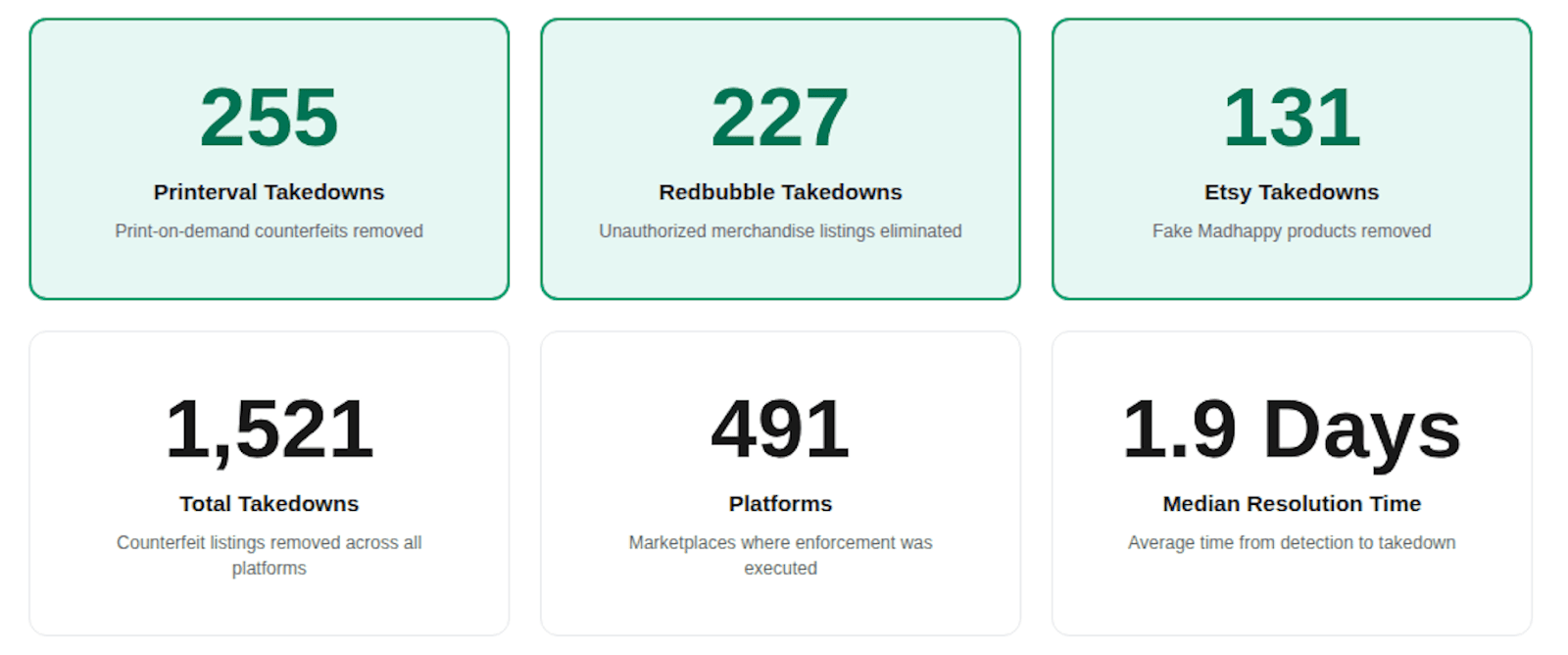
1,521 counterfeit listings removed across 491 platforms.
Print-on-demand sites took the biggest hit:
255 takedowns on Printerval
227 takedowns on Redbubble
131 takedowns on Etsy
87 takedowns on TikTok Shop
1.9 days median resolution time. Most fakes came down within 48 hours, fast enough to cut off sales before they added up.
90% resolution rate. Podqi closed 9 out of 10 cases. The remaining 10% were either unresponsive platforms or escalations requiring legal action.
491 platforms covered. Major marketplaces, niche print-on-demand sites, social commerce - anywhere Madhappy products showed up online.
142 fake domains taken down, including clones of the official store.
"The Podqi team has helped us tremendously in taking down counterfeit sites — to make sure our brand and customers are protected." — Peiman Raf, Co-Founder & CEO, Madhappy
Madhappy's counterfeit problem didn't end with the initial sweep — it evolved. Print-on-demand platforms reset quickly: old listings come down, new ones go up. Podqi's continuous monitoring means Madhappy's team isn't playing catch-up. New infringements are flagged within hours, repeat offenders are tracked across platforms, and enforcement runs in the background while the brand focuses on what it actually does; building community around mental health.